
Dec 11, 2025
Smart Warehouse Planning for High-Efficiency Logistics and Inventory Management
In the modern industrial landscape, factory planning and plant layout have become critical determinants of operational efficiency, cost control, and sustainable production. With increasing demands for high-quality manufacturing and lean processes, companies are seeking solutions that integrate architectural design with production requirements. A key aspect of this integration is the precise matching of building parameters with spatial utilization, ensuring every square meter contributes to productivity without incurring unnecessary costs. In this blog post, Shoebill Technology, as high quality lean factory layout services provider, will share insights on smart factory planning and plant layout for space utilization.
Effective smart factory planning begins with accurate architectural parameter design. This includes considerations such as floor height, load-bearing capacity, and column grid arrangements, all tailored to the specific production processes housed within the facility. Shoebill Technology applies differentiated standards depending on factory function. For instance, aluminum alloy production plants feature a single-floor steel structure with a height of 16.5 meters. The load-bearing capacity varies by functional area: 23 T/㎡ in smelting zones, 20 T/㎡ in die-casting areas, and 10 T/㎡ in mold repair sections.
In contrast, line control production plants often utilize concrete structures with a lower floor height of 9.5 meters for the first floor and 7.5 meters for the second floor, with load capacities of 5 T/㎡ and 2 T/㎡ respectively. Multi-story office buildings are designed with varying floor heights—4.8 meters for the first floor, 4.6 meters for the second, and 3.6 meters for floors three to six—while load-bearing capacities are optimized at 0.5 T/㎡ for the first floor and 0.2 T/㎡ for subsequent levels. Additionally, rooftops are engineered to accommodate 30 kg/㎡ of photovoltaic equipment, providing space for renewable energy integration.
A critical component of plant layout optimization is the column grid, which must balance structural integrity, equipment placement, and cost efficiency. Shoebill Technology carefully designs column spacing to match production line requirements and warehouse storage configurations. For example, aluminum alloy production buildings utilize a 30×8 m column grid to accommodate large-scale manufacturing lines, while line control and heavy component buildings are planned with a 12×10 m grid for precise equipment alignment. Material and finished goods warehouses feature even larger spans of 9.3×33.5 m in automated storage areas, allowing for high-density storage and unimpeded forklift or crane operation.
This level of precision ensures that columns do not obstruct production workflows while avoiding over-engineering that increases construction costs. The result is a harmonious combination of structural stability, production efficiency, and spatial optimization—fundamental principles of smart factory planning and plant layout.
Efficient smart factory planning requires a delicate balance between production requirements and construction expenditure. By aligning floor heights, load-bearing capacities, and column grids with specific operational needs, Shoebill Technology reduces wasted space and unnecessary structural reinforcement. This approach translates to significant cost savings while maintaining the flexibility to accommodate future production upgrades or line expansions.
Moreover, the integration of energy-conscious design elements, such as PV-ready rooftops, demonstrates a holistic understanding of modern industrial priorities. It reflects the increasing importance of sustainability in plant layout decisions, ensuring that smart factories not only optimize production but also contribute to environmental responsibility.
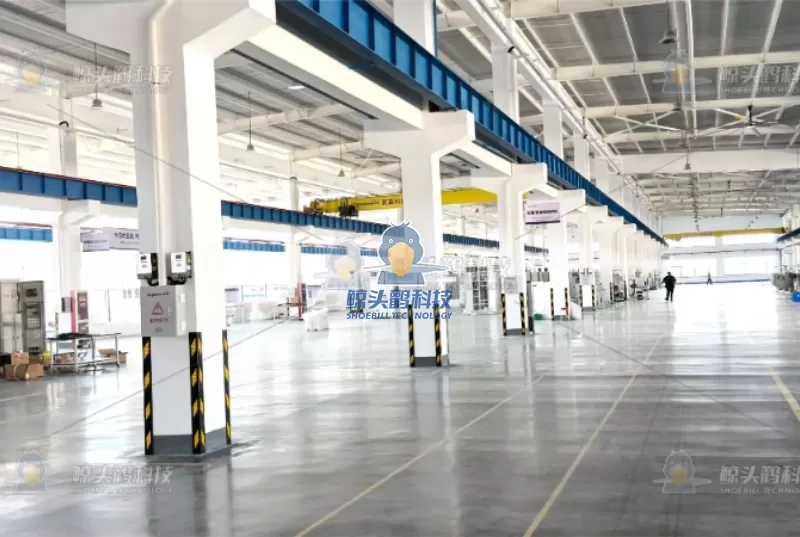
The central goal of plant layout in smart factories is maximizing usable space. Shoebill Technology's methodical approach considers both the macro and micro aspects of spatial planning. At the macro level, building footprints are designed to facilitate efficient material flow, minimize transportation distances between production zones, and streamline logistics operations. At the micro level, interior layouts account for machinery dimensions, safety corridors, and storage access, ensuring that no space is underutilized or obstructed.
For example, the careful placement of columns and load-bearing zones allows production lines to operate unimpeded while simultaneously enabling high-density storage in warehouse sections. Such optimization not only improves throughput but also enhances worker safety and ergonomics, key factors in modern smart factories.
An often-overlooked aspect of smart factory planning and plant layout is flexibility. Shoebill Technology emphasizes designs that can adapt to evolving production technologies and shifting market demands. Adjustable floor load capacities, modular column arrangements, and variable ceiling heights allow factories to accommodate new machinery, automation systems, or expanded production lines without requiring costly structural modifications. This forward-thinking approach ensures that investments in smart factory infrastructure remain valuable over the long term.
Technology plays a pivotal role in smart factory planning. Advanced simulation tools and CAD-based modeling enable precise visualization of production lines, material flows, and spatial utilization. Shoebill Technology leverages these tools to test multiple layout scenarios, identifying the most efficient configurations before construction begins. This reduces errors, prevents costly retrofits, and allows for data-driven decision-making in the design process.
The intersection of smart factory planning and plant layout with precise architectural design is critical for maximizing efficiency, minimizing costs, and supporting sustainable manufacturing. Shoebill Technology exemplifies this principle by integrating detailed floor height, load-bearing, and column grid specifications with the unique demands of different production types. Through meticulous planning, the company achieves optimal space utilization, seamless workflow, and long-term adaptability. As manufacturing continues to evolve, the integration of architectural precision, technological tools, and operational requirements will define the next generation of high-performance smart factories

Add: Room 501, Building 1, Lane 668, Defu Road,Jiading District,Shanghai, China
Tel: 021-61354399
Contact: Mr. Chen