
Dec 15, 2025
From Common Planning Traps to Structured New Factory Blueprint
In modern manufacturing, a machining workshop layout is not simply a matter of placing machines on a shop floor. It is a strategic system that directly determines production efficiency, equipment utilization, material flow stability, and operational safety. A layout that does not match the actual production model will inevitably lead to bottlenecks, excessive handling, frequent machine changeovers, and hidden risks.
Shoebill Technology approaches machining workshop layout design from a core principle: the layout must be precisely aligned with the enterprise’s production mode. Whether the factory focuses on multi-variety small-batch manufacturing or large-scale stable output, the layout should serve the production logic rather than force production to adapt to the space. In this blog post, Shoebill Technology, as high quality workshop layout services provider, will share insights on precisely matching lean machining workshop layouts with production models.
A machining workshop layout defines how equipment, operators, materials, and information move within the production space. From raw material entry to finished part storage, every step is influenced by spatial arrangement. Poorly planned layouts increase non-value-added movement, extend production cycles, and reduce responsiveness to order changes.
Shoebill Technology treats layout planning as an extension of process engineering. Before finalizing any machining workshop layout, production volume, product variety, routing complexity, and future scalability are evaluated. This ensures that the physical structure of the workshop supports the intended production rhythm rather than constraining it.
Multi-variety small-batch manufacturing is characterized by frequent product changes, diverse part specifications, and fluctuating order quantities. In this scenario, flexibility and rapid adjustment are more critical than absolute throughput.
For this production model, a machining workshop layout must prioritize short setup times, easy equipment reconfiguration, and clear functional zoning. Shoebill Technology typically adopts a discrete layout approach, grouping CNC machines in a way that supports fast switching between different parts.
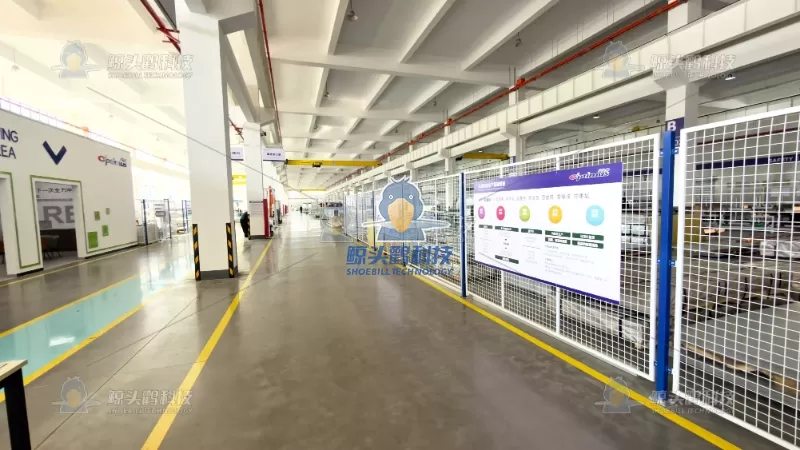
Machines are arranged along both sides of clearly marked yellow floor lines, creating defined production zones while maintaining visual order. Blue support racks and standardized aisles are introduced to organize tooling, fixtures, and semi-finished products. This structure allows operators to quickly access required resources without interrupting other processes.
In one machining workshop designed for this production mode, the discrete layout enabled simultaneous manufacturing of five different mechanical component specifications. Despite the variety, equipment changeover times were kept minimal, and production scheduling remained stable. This demonstrates how a well-planned machining workshop layout can absorb complexity without sacrificing efficiency.
Order volatility is a major challenge in small-batch environments. A rigid layout makes each new order disruptive, while a flexible layout absorbs change with minimal impact.
Shoebill Technology incorporates modular thinking into machining workshop layout design. Equipment spacing, power supply routing, and compressed air interfaces are planned so machines can be repositioned or replaced without major reconstruction. Functional areas are concentrated rather than scattered, ensuring that workflow adjustments do not create confusion.
This flexibility allows workshops to respond quickly to new customer requirements. Instead of redesigning the entire production flow, minor adjustments within the existing machining workshop layout are sufficient to accommodate new parts or processes.
In contrast to small-batch manufacturing, large-volume stable production emphasizes consistency, takt time control, and minimal handling. Here, the machining workshop layout should support continuous flow and predictable output.
Shoebill Technology typically applies an automated line layout for this production model, forming a “one-flow” system. Equipment is arranged strictly according to process sequence, enabling parts to move smoothly from one operation to the next without unnecessary backtracking.
A representative example is a brake caliper machining workshop designed around the process chain of “raw material – rough machining – finish machining – inspection – warehousing.” Automated conveying systems connect each stage, ensuring stable part transfer and reducing manual intervention.
After implementing this machining workshop layout, the customer achieved a 50% increase in production efficiency while simultaneously lowering operational risk. The clear process flow reduced human error, and automation stabilized output quality.
Continuous flow is the core objective of large-scale machining workshop layout planning. To achieve this, Shoebill Technology focuses on balancing cycle times across processes and minimizing intermediate buffers.
Equipment is selected and positioned so that no single operation becomes a bottleneck. Inspection stations are integrated into the flow rather than isolated, preventing quality issues from accumulating downstream. The result is a machining workshop layout that delivers predictable output with minimal supervision.
Regardless of production model, equipment spacing is a critical aspect of machining workshop layout design. Insufficient space restricts operation and maintenance, while excessive space increases walking distances and material handling time.
Shoebill Technology calculates equipment spacing based on machine dimensions, operator movement, tooling changes, and maintenance requirements. Dedicated access paths are reserved for servicing and emergency response, ensuring that daily operations are not disrupted by maintenance activities.
This approach improves both productivity and safety, as operators can work efficiently without navigating congested areas.
An often overlooked factor in machining workshop layout is auxiliary system integration. Coolant recovery, chip disposal, and waste handling significantly affect workshop cleanliness and long-term operating costs.
Shoebill Technology designs centralized coolant recovery systems and designated waste processing zones within the machining workshop layout. By avoiding scattered disposal points, the workshop remains orderly, and environmental risks are reduced.
Centralized systems also simplify maintenance and monitoring, contributing to a cleaner and more controlled production environment.
Clear visual management is essential for efficient workshops. Floor markings, color-coded zones, and standardized signage are integrated into the machining workshop layout to guide operators and logistics personnel.
Yellow lines define equipment boundaries and walkways, while blue racks and channels indicate material and tooling areas. This visual structure reduces confusion, prevents cross-traffic conflicts, and enhances overall operational discipline.
Safety is not treated as an add-on but as an inherent part of layout logic. Emergency exits, fire lanes, and equipment safety zones are planned from the initial layout stage rather than retrofitted later.
The effectiveness of a machining workshop layout is ultimately measured by performance outcomes. In a customer project implemented by Shoebill Technology, the optimized layout resulted in a 30% increase in equipment utilization and a 25% reduction in production cycle time.
These improvements were not driven by new machines alone, but by aligning the layout precisely with the customer’s production model. Material flow became smoother, equipment downtime decreased, and scheduling accuracy improved.
Such results highlight the tangible value of scientifically planned machining workshop layouts.
Production requirements evolve over time. A machining workshop layout that cannot scale will quickly become obsolete.
Shoebill Technology incorporates future expansion considerations into layout planning. Reserved spaces, expandable logistics routes, and adaptable utility systems ensure that the workshop can grow without major disruption. This forward-looking approach protects long-term investment and supports sustainable development.
A machining workshop layout is a strategic asset that must be precisely matched to the production model it serves. Multi-variety small-batch manufacturing requires flexible, discrete layouts that support rapid change, while large-scale stable production benefits from automated, continuous flow designs.
By grounding layout decisions in production logic, Shoebill Technology delivers machining workshop layouts that improve efficiency, enhance equipment utilization, and reduce operational risk. The proven performance gains achieved by its customers demonstrate that precise alignment between layout and production mode is not theoretical—it is a practical path to higher manufacturing competitiveness.

Add: Room 501, Building 1, Lane 668, Defu Road,Jiading District,Shanghai, China
Tel: 021-61354399
Contact: Mr. Chen