
Oct 11, 2025
Six Strategies to Build Smart Logistics Warehouse for “Unbelievably” Efficient Production
Lean factory design is no longer limited to internal efficiency, cost control, and waste reduction. In modern smart manufacturing environments, it has evolved into a comprehensive system that balances operational excellence with communication, transparency, and brand expression. Visitor pathway planning, when integrated thoughtfully into lean factory design, becomes a strategic interface between production systems and external stakeholders. In this blog post, Shoebill Technology, as high quality lean factory layout services exporter, will share the importance of lean factory design integrating visitor pathways and brand identity.
In traditional factories, visitor routes were often treated as secondary considerations, added after production layouts were finalized. In contrast, lean factory design regards visitor pathways as an integral part of the spatial planning process. The objective is not simply to guide people through a facility, but to create a controlled, efficient, and informative flow that aligns with lean principles such as clarity, standardization, and value creation.
At Shoebill Technology, visitor corridors are planned simultaneously with production lines, logistics routes, and safety zones. This parallel planning ensures that visitor movement does not cross with material flow, personnel circulation, or critical manufacturing operations. By embedding visitor pathways into the early stages of lean factory design, the factory achieves spatial efficiency while transforming visits into structured, value-oriented experiences.
A key characteristic of Shoebill Technology’s approach is the differentiated design of visitor routes based on the profile and purpose of each visitor group. Lean factory design emphasizes meeting specific needs with minimal waste, and this principle extends naturally to visitor planning.
For government officials and media representatives, the visitor route prioritizes the exhibition hall and selected showcase areas. The layout highlights innovation capabilities, intelligent manufacturing achievements, and corporate social responsibility initiatives. The route is designed as a one-directional loop, ensuring smooth circulation without backtracking. This not only reflects lean flow principles but also delivers a clear, concise narrative aligned with public communication objectives.
For customers and business partners, the visitor pathway expands beyond the exhibition hall to include key production areas such as the aluminum alloy workshop, drive-by-wire workshop, Southern Trina workshop, R&D facilities, and intelligent warehousing zones. Lean factory design principles guide the sequence of these spaces, allowing visitors to understand the logical progression from materials and processes to finished products and storage. At the same time, sensitive processes and proprietary technologies are shielded through spatial zoning and visual controls, balancing openness with confidentiality.
For professional evaluation and audit institutions, the visitor route is designed to cover the complete process chain. This full-process pathway supports technical assessments, compliance reviews, and system evaluations. Lean factory design ensures that the route is systematic, traceable, and consistent with documented workflows, reinforcing credibility and operational transparency.
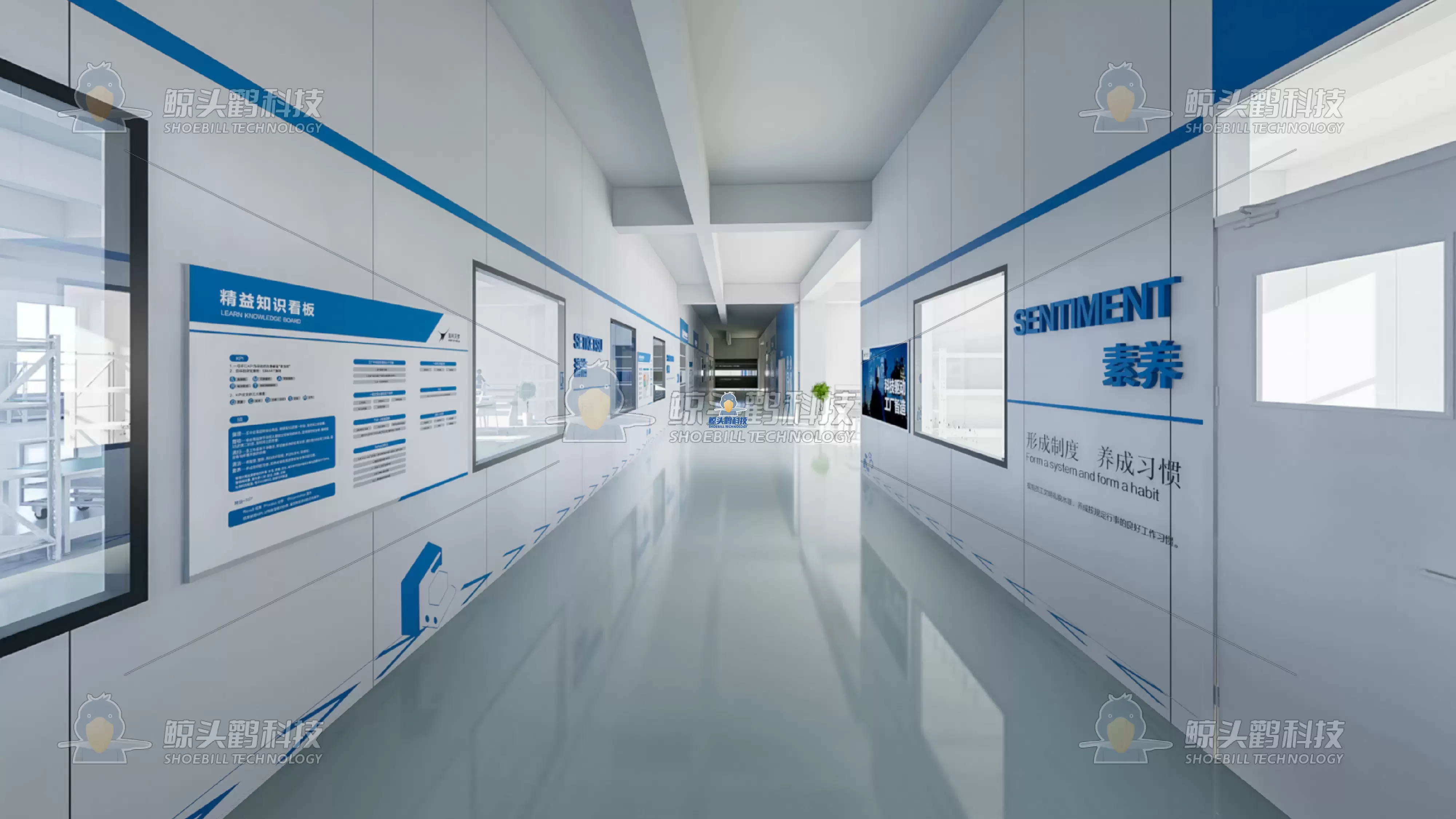
One of the most critical challenges in integrating visitor pathways into lean factory design is ensuring that visits do not disrupt production efficiency. Shoebill Technology addresses this through strict physical and visual separation strategies.
Visitor corridors are clearly defined as independent circulation systems, separated from production zones by glass partitions or enclosed observation passages. This eliminates the need for visitors to enter cleanrooms or wear protective clothing, reducing contamination risks and operational interruptions. From a lean perspective, this approach removes unnecessary steps, reduces variability, and protects process stability.
In cleanroom environments, glass isolation walls allow visitors to observe operations without affecting environmental controls. Specially designed observation windows provide real-time visibility into critical processes, enabling understanding without physical access. These design elements reflect lean factory design’s emphasis on visual management and transparency, applied in a controlled and disciplined manner.
Lean factory design relies heavily on visual management to convey information quickly and accurately. Shoebill Technology extends this concept to visitor corridors, transforming them into immersive brand communication spaces.
Walls along visitor pathways incorporate product element icon systems, process diagrams, and technology highlights. These visual elements are standardized in style, color, and layout, reinforcing brand consistency while supporting easy comprehension. The integration of visual storytelling aligns with lean principles by reducing cognitive load and delivering information efficiently.
In certain workshops, glass walls along the visitor corridor present a complete view of the product manufacturing process. This transparent presentation is complemented by carefully placed brand logos and core cultural slogans on adjacent walls. The result is a balanced environment where production reality and brand messaging coexist without competing for attention.
Beyond functionality, lean factory design also shapes the aesthetic language of the factory environment. Shoebill Technology’s visitor corridors emphasize a modern, international visual style that reflects its positioning as a technology-driven enterprise.
Materials such as glass, metal frames, and neutral-toned finishes create a clean and professional atmosphere. Lighting is designed to highlight both production areas and informational displays, ensuring clarity without distraction. The overall spatial experience communicates order, precision, and technological maturity, values that are central to lean factory design philosophy.
This aesthetic coherence is not superficial. It reinforces trust among visitors, supports brand differentiation, and enhances the perceived value of products and services. From a lean perspective, every design element serves a purpose, avoiding decorative excess while maintaining strong visual impact.
Lean factory design places people at the center of system planning, and this human-centered approach is evident in Shoebill Technology’s visitor pathway design. Visitor comfort, safety, and clarity of orientation are treated as essential requirements rather than optional features.
Corridor widths, viewing heights, signage placement, and rest points are designed based on ergonomic principles. Wayfinding is intuitive, supported by consistent symbols and directional cues. These details reduce confusion, shorten visit durations, and ensure that information is absorbed efficiently.
By applying lean thinking to visitor experience design, Shoebill Technology minimizes unnecessary movement, waiting, and misunderstanding. This not only improves visit quality but also reduces the internal resources required to manage and guide visits.
In lean factory design, every space must create value. Shoebill Technology treats visitor corridors as brand assets rather than passive infrastructure. Each visit becomes an opportunity to demonstrate operational excellence, technological capability, and corporate culture.
The seamless integration of production visibility, brand storytelling, and spatial efficiency ensures that visitors gain a comprehensive understanding of the enterprise within a limited timeframe. This structured exposure supports relationship building with governments, partners, and evaluators, while reinforcing Shoebill Technology’s position in the smart manufacturing landscape.
Importantly, this value creation does not come at the expense of production performance. Lean factory design ensures that visitor pathways enhance external perception without introducing internal waste or risk.
The integration of visitor pathway design and brand image presentation represents an advanced application of lean factory design in modern smart factories. Shoebill Technology’s approach demonstrates how careful planning, differentiated routing, visual management, and human-centered thinking can transform visitor corridors into strategic communication tools.
By embedding visitor access into the core logic of lean factory design, Shoebill Technology achieves a rare balance: transparent and engaging factory visits that coexist with efficient, secure, and uninterrupted production. This model provides valuable insights for manufacturers seeking to align operational excellence with brand expression in an increasingly competitive and visible industrial environment.

Add: Room 501, Building 1, Lane 668, Defu Road,Jiading District,Shanghai, China
Tel: 021-61354399
Contact: Mr. Chen