
Sep 10, 2025
From land to benchmarks, Shoebill Technology empowers the entire life cycle of smart factories!
A smart factory floor plan is no longer a simple arrangement of production lines; it is a carefully orchestrated system that balances workflow efficiency, material handling, and functional zoning. For multi-story manufacturing facilities, strategic vertical space utilization is critical. Poorly designed multi-level layouts often lead to inefficient cross-floor transport, bottlenecks in production, and underutilized capacity. A well-structured smart factory floor plan ensures that each floor’s function aligns with production processes while optimizing logistics flow.
Vertical integration in factory design allows for the segregation of heavy-duty operations, assembly, storage, and administrative functions without compromising accessibility. By aligning production requirements with floor-specific functionalities, companies can streamline workflows, reduce material handling time, and enhance overall operational efficiency. In this blog post, Shoebill Technology, a professional workshop floor plan layout service provider, will share the features of smart factory floor plan and efficient use of vertical space.
A core principle of a high-performance smart factory floor plan is allocating functional areas according to production characteristics and operational needs.
Ground Floor for Heavy Operations and Raw Materials
The first floor typically hosts high-load operations such as machining workshops, raw material storage, and loading/unloading zones. Positioning these areas near external access points, such as docks, allows for efficient material entry and exit. High floor load capacities (up to 5T/㎡) are designed to safely support heavy machinery and raw material stockpiles.
Intermediate Floors for Assembly and Semi-Finished Storage
The second floor often accommodates assembly workshops, semi-finished product storage, and operational management offices. Locating these areas adjacent to production floors enables managers to maintain close supervision and ensures smooth transfer of materials from machining to assembly. Floor load standards are adapted for lighter operations, typically around 2T/㎡, balancing safety and structural efficiency.
Mezzanines and Upper Levels for Support Functions
Upper floors or mezzanines can serve as auxiliary spaces, including employee rest zones, administrative offices, or guided observation areas. These zones are intentionally designed to minimize interference with core production areas while taking advantage of underutilized vertical space. Lightweight floor construction and moderate height allowances (e.g., 3.9m) make these areas functional yet non-intrusive.
By zoning floors according to operational weight, workflow needs, and human traffic patterns, a smart factory floor plan transforms vertical space into a highly efficient asset.
Vertical space utilization is closely linked to logistics efficiency. In multi-level factories, inefficient cross-floor transport can significantly slow production. A smart factory floor plan addresses these challenges by integrating material handling solutions tailored to vertical workflows.
Elevators and Lifts for Semi-Finished Products
Lifts and vertical conveyors are installed to transport semi-finished products from machining floors to assembly floors seamlessly. This ensures that production flows without interruptions, reduces labor dependency, and maintains consistent cycle times.
Integration with Automated Guided Vehicles (AGVs)
For smart factory setups, vertical integration can be paired with AGVs and automated logistics solutions. AGVs can interact with lifts or mezzanine access points, enabling the rapid movement of components across floors while maintaining precise production sequencing.
Load-Adaptive Vertical Transport Design
Different production areas have specific weight and volume requirements. Lifts and conveyors are designed to handle these variations efficiently, avoiding delays or structural strain. For example, machinery from the first floor may require high-capacity lifts, while lightweight components moving to upper administrative zones can use smaller transport mechanisms.
Through meticulous planning of vertical logistics, a smart factory floor plan can achieve significant efficiency gains—studies have shown potential improvements of 40% in cross-floor transport efficiency in well-designed multi-story factories.
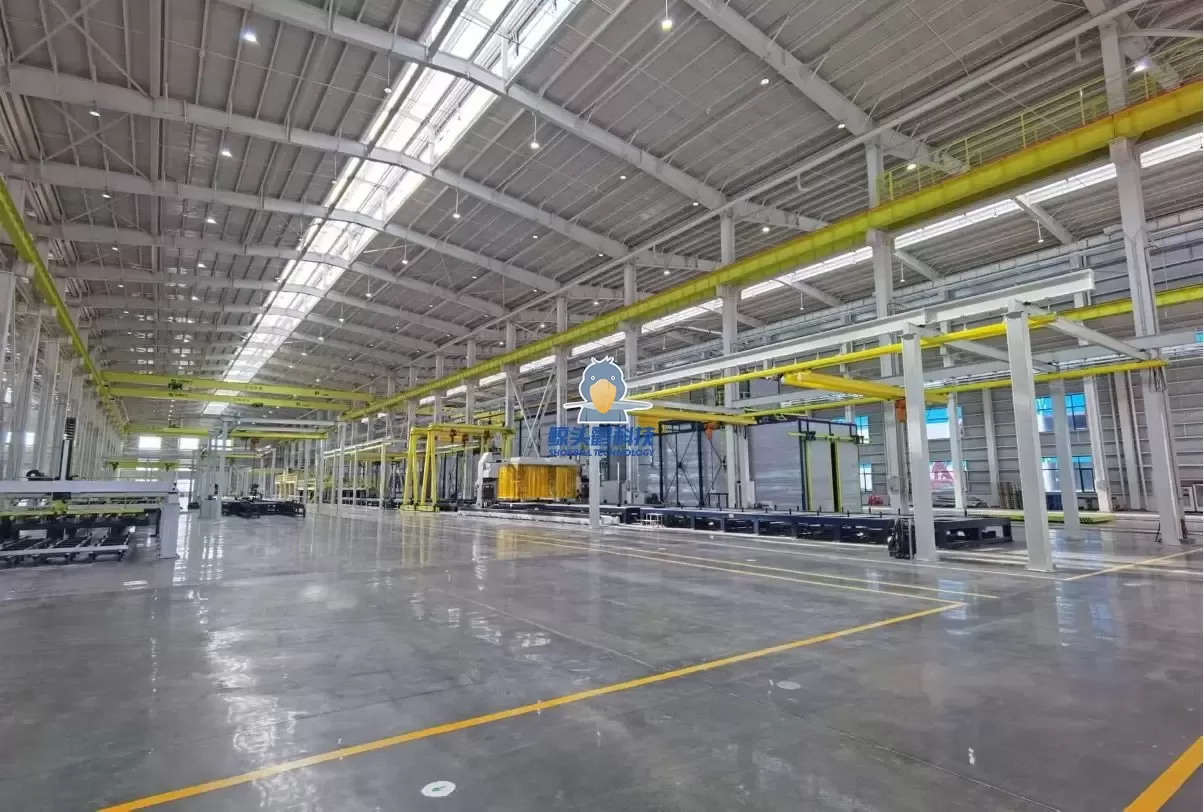
Smart vertical space utilization extends beyond assigning functions to floors; it includes calculating optimal floor heights and load capacities.
Tailoring Floor Load to Production Needs
Machine-intensive zones demand higher structural reinforcement, while assembly and office areas require moderate load support. This differentiation reduces unnecessary construction costs and ensures structural safety.
Layered Ceiling Heights for Workflow Flexibility
High ceilings on production floors accommodate large machinery, ventilation, and material handling equipment. Intermediate floors can adopt standard ceiling heights optimized for personnel movement, storage, and administrative use. Mezzanine or observation floors may have lower heights to reduce construction volume without limiting functionality.
Structural Considerations for Future Adaptability
Designing floors with adaptable load capacities enables factories to reconfigure workflows or add new production lines with minimal structural modifications, a key aspect of smart factory planning.
A hallmark of a high-efficiency smart factory floor plan is functional overlap, where non-core areas exploit vertical space without impeding primary production zones.
Observation and Training Areas Above Production Floors
Mezzanine spaces allow guided tours or staff training above active production lines, providing visibility without disrupting workflow.
Administrative and Support Functions
Offices, meeting rooms, and support facilities can occupy upper floors or mezzanines, freeing core production areas for operational use. This layered design maximizes building volume utilization by up to 50%, converting what would otherwise be idle vertical space into productive zones.
Integration with Safety and Compliance
Upper-level spaces can also house safety monitoring stations or environmental control units, maintaining compliance without occupying valuable production areas.
By creatively utilizing vertical space for secondary functions, a smart factory floor plan increases operational efficiency while maintaining safety and accessibility.
The ultimate goal of a smart factory floor plan is a harmonized workflow, where material movement, personnel activity, and machine operations are seamlessly coordinated across vertical levels.
Sequential Floor Layouts
Arranging floors in a logical production sequence—from raw material intake and machining to assembly and packaging—reduces backtracking and material congestion.
Integrated Information Systems
Digital tools and smart sensors can monitor cross-floor logistics, alerting personnel to delays and optimizing lift or conveyor scheduling.
Continuous Performance Assessment
Smart factories leverage real-time data to evaluate the efficiency of vertical workflows. Metrics such as transport cycle times, floor occupancy rates, and machine utilization inform continuous improvement initiatives.
By combining physical planning with digital oversight, a smart factory ensures that vertical space contributes directly to production effectiveness.
To translate these principles into practice, manufacturing planners should focus on the following:
Conduct a detailed assessment of production workflows and material flows.
Assign floor functions according to weight load requirements, process sequence, and supervisory needs.
Implement vertical transport solutions tailored to the volume and weight of materials.
Design upper floors for auxiliary or non-core functions to maximize vertical space utilization.
Plan structural elements and ceiling heights to accommodate machinery, storage, and staff movement.
Integrate smart monitoring systems to continuously optimize cross-floor efficiency.
These strategies allow factories to make the most of every square meter, reduce operational inefficiencies, and future-proof vertical space utilization.
A smart factory floor plan is more than a blueprint; it is a strategic tool that transforms vertical space into a competitive advantage. By carefully aligning floor functions, optimizing load capacities, and integrating efficient cross-floor logistics, manufacturers can achieve remarkable improvements in productivity and space utilization. The combination of structural planning, functional zoning, and smart logistics ensures that multi-story factories operate seamlessly, safely, and efficiently.
Investing in vertical space planning within a smart factory framework is no longer optional—it is essential for modern manufacturing operations seeking higher output, reduced waste, and sustained operational excellence.

Add: Room 501, Building 1, Lane 668, Defu Road,Jiading District,Shanghai, China
Tel: 021-61354399
Contact: Mr. Chen