
Oct 11, 2025
Six Strategies to Build Smart Logistics Warehouse for “Unbelievably” Efficient Production
In factory operations, the loading and unloading dock is not a peripheral facility but a decisive logistics node. Its design quality directly shapes throughput speed, labor intensity, safety performance, and overall supply chain responsiveness. Within factory warehouse logistics, a dock that is mismatched to vehicle types, material characteristics, or automation levels can quickly become a bottleneck, offsetting investments made elsewhere in warehousing or production.
Taking “precise adaptation between dock design and logistics efficiency” as a core principle, Shoebill Technology integrates vehicle data analysis, automation planning, and safety zoning into dock solutions that are both practical and scalable. This article explores how thoughtful dock design aligns with real operational needs and why it has become a critical factor in modern factory logistics systems. In this blog post, Shoebill Technology, as professional lean logistics planning service provider, will share insights on smart factory warehouse logistics and dock design for efficiency.
In many factories, dock planning is treated as a fixed architectural decision rather than an operational strategy. In reality, docks determine how efficiently materials flow between external transport and internal processes. Poorly designed docks often lead to frequent manual adjustments, temporary ramps, waiting vehicles, and increased safety risks.
Within factory warehouse logistics, docks serve three interconnected roles. First, they synchronize inbound raw materials with production rhythms. Second, they enable outbound finished goods to leave the facility on schedule. Third, they act as safety interfaces where people, vehicles, and equipment converge. When these roles are not balanced, inefficiencies multiply quickly.
Shoebill Technology approaches dock planning as a logistics optimization task rather than a construction task. By aligning dock parameters with actual operating data, factories can eliminate structural inefficiencies that are otherwise locked in for years.
One of the most underestimated factors in dock performance is height compatibility. A dock that is too high or too low for common trucks forces operators to rely on bridging devices, forklifts with unsafe angles, or manual handling, all of which reduce efficiency.
In factory warehouse logistics planning, Shoebill Technology begins with a detailed survey of truck types, tailboard heights, and usage frequency. Instead of designing for theoretical standards, the dock height is set based on the most frequently used vehicle category. This ensures that the majority of loading and unloading tasks can be performed with minimal adjustment.
By prioritizing frequency over extremes, factories avoid overengineering for rare scenarios while achieving smoother daily operations. The result is faster docking, reduced equipment wear, and a more predictable logistics flow.
Automation has transformed internal warehousing, but its benefits often stop at the dock if the interface is not designed accordingly. Automated loading and unloading require precise spatial planning, stable platforms, and seamless integration with handling equipment.
Shoebill Technology incorporates robotic loading and unloading systems, such as mechanical arm solutions comparable to the EW908 model, directly into dock layouts. These systems enable automated transfer of raw materials and finished goods between trucks and internal conveyors or storage zones.
From a factory warehouse logistics perspective, automated docks deliver multiple advantages. Labor intensity is significantly reduced, occupational injury risks are lowered, and handling efficiency can exceed manual operations by more than three times. More importantly, automation brings consistency, allowing factories to maintain stable throughput even during labor shortages or peak seasons.
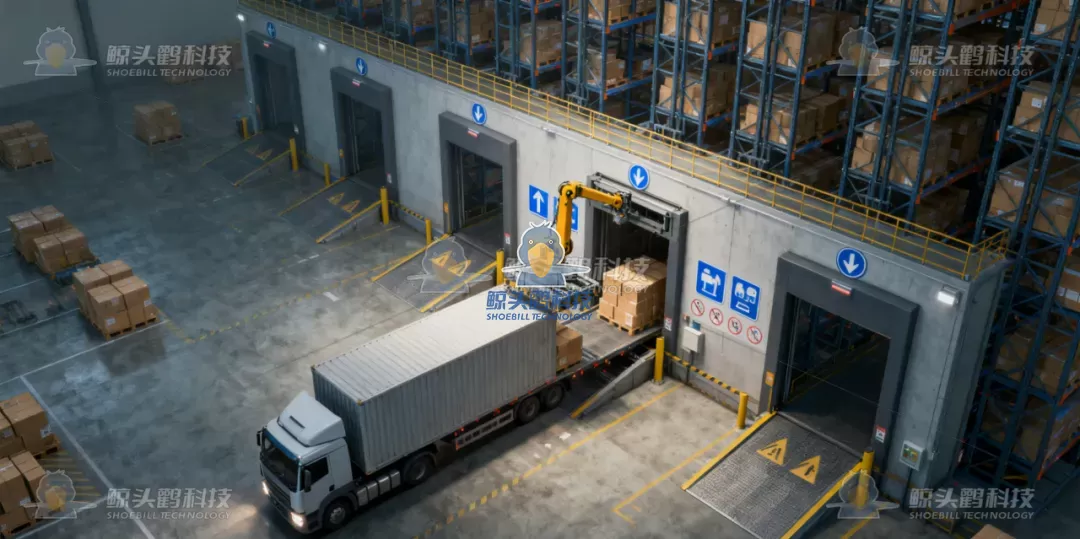
As logistics intensity increases, so does the risk of accidents at dock areas. People, forklifts, automated equipment, and trucks often operate simultaneously within limited space. Without clear zoning, even well-equipped docks can become hazardous.
Shoebill Technology emphasizes visual and physical separation within dock environments. Yellow safety lines clearly define loading zones, vehicle paths, and pedestrian corridors. Warning signs and standardized markings ensure that operators and drivers understand movement boundaries at a glance.
In factory warehouse logistics operations, this zoning approach minimizes human-vehicle conflicts and supports compliance with safety management systems. Rather than relying solely on training, the dock itself becomes a safety control mechanism embedded in daily workflows.
Automotive component factories typically face high inbound and outbound frequency, strict delivery schedules, and diverse material forms. In one such project, Shoebill Technology designed dock heights around medium-duty trucks, which accounted for the majority of inbound raw material transport.
Automated mechanical handling systems were integrated to support repetitive loading tasks, while safety zones separated operators from moving vehicles. This combination allowed the factory to maintain high dock utilization without compromising safety.
From a factory warehouse logistics standpoint, this case highlights the importance of tailoring dock design to industry-specific transport patterns rather than relying on generic standards. The dock became an extension of the production line rather than a passive transfer point.
Not all materials can be handled through standard docks. Large castings, heavy die-casting blanks, or precision components require dedicated solutions to ensure both safety and efficiency.
Shoebill Technology designs specialized docks based on material characteristics. For heavy industrial materials, reinforced dock structures are paired with auxiliary equipment such as excavator-assisted loading systems, often marked with high-visibility orange equipment to distinguish them from standard operations. This ensures stable handling of oversized loads without disrupting routine logistics activities.
For precision components, dock layouts emphasize vibration control, controlled movement paths, and gentle transfer interfaces. Within factory warehouse logistics, such differentiation prevents damage-related losses and preserves product quality throughout the handling process.
Effective dock design relies on accurate operational data rather than assumptions. Vehicle arrival patterns, peak time distribution, material flow rates, and handling cycle times all influence dock performance.
Shoebill Technology integrates data collection into early planning stages, allowing dock layouts to reflect real logistics behavior. This approach supports scalable factory warehouse logistics, where docks can adapt to future volume growth or shifts in transport modes without major reconstruction.
By treating dock design as a dynamic logistics asset, factories gain flexibility and long-term cost efficiency rather than static infrastructure.
While automation plays an increasing role, human operators remain integral to dock activities. Poor ergonomic design leads to fatigue, errors, and higher turnover, all of which undermine logistics efficiency.
In factory warehouse logistics systems designed by Shoebill Technology, dock heights, equipment placement, and operator movement paths are optimized to reduce unnecessary bending, lifting, or walking. Clear sightlines and intuitive layouts support faster decision-making and smoother coordination between humans and machines.
This human-centered approach ensures that efficiency gains are sustainable rather than achieved at the expense of workforce well-being.
Investments in dock design are often evaluated only on initial construction cost. However, their true value lies in long-term operational performance. A well-adapted dock reduces handling time per vehicle, minimizes accident-related downtime, and supports higher logistics throughput without proportional labor increases.
Within factory warehouse logistics, docks designed for precision adaptation become leverage points for competitiveness. They enable factories to respond quickly to order fluctuations, accommodate new vehicle types, and integrate emerging automation technologies with minimal disruption.
Shoebill Technology’s approach demonstrates that dock design is not a static engineering task but a continuous alignment between physical infrastructure and logistics strategy.
As factories pursue higher efficiency, lower risk, and greater flexibility, the role of loading and unloading docks has evolved from basic infrastructure to strategic logistics assets. Precision adaptation—matching dock height to vehicle profiles, integrating automation, zoning for safety, and customizing for material characteristics—defines the next generation of factory warehouse logistics.
By grounding dock design in real operational data and practical use cases, Shoebill Technology delivers solutions that are not only technically sound but operationally effective. In modern manufacturing environments, such precision at logistics nodes often determines whether efficiency gains are theoretical or truly realized on the shop floor.

Add: Room 501, Building 1, Lane 668, Defu Road,Jiading District,Shanghai, China
Tel: 021-61354399
Contact: Mr. Chen