In the contemporary industrial landscape, the efficiency of smart factory layout extends far beyond the arrangement of production lines. One critical yet often underestimated aspect is the design and placement of auxiliary facilities. These facilities, including power distribution rooms, compressed air systems, wastewater treatment stations, and environmental control areas, are integral to ensuring uninterrupted production, safety compliance, and energy efficiency. In this blog post, Shoebill Technology, as high quality lean factory design service provider, will share the strategic planning of auxiliary facilities in smart factory layout for enhanced production support.
Integrating Auxiliary Facilities into Smart Factory Layout
A well-structured smart factory layout recognizes auxiliary facilities as core components rather than peripheral elements. Effective integration requires a comprehensive analysis of production demands, resource consumption, and safety considerations. For instance, power-intensive areas, such as melting or assembly zones, necessitate nearby high-capacity distribution rooms to minimize energy loss and enhance power stability. By strategically positioning auxiliary spaces adjacent to high-demand production areas, factories reduce operational downtime and ensure seamless energy flow.
Shoebill Technology emphasizes a holistic approach to facility integration. This includes line-controlled distribution rooms, general power distribution rooms, hazardous material storage, experimental electrical rooms, compressed air stations, HVAC systems, and firefighting pump stations. Each of these spaces is meticulously aligned with the production workflow, facilitating a coordinated and responsive operational environment.
Energy and Resource-Oriented Auxiliary Planning
Energy efficiency is a critical consideration in modern smart factory layouts. Shoebill Technology’s methodology involves precise quantification of water, electricity, compressed air, and thermal energy requirements. For example, in a lightweight automotive production zone, water consumption for the first phase of the threshold beam area was calculated at 5 units, circulating water at 407.9 units, electricity at 3,689.6 units, and compressed air at 96.8 units. Such detailed calculations inform the design of auxiliary facilities, ensuring that supply systems are neither over- nor under-dimensioned. This not only reduces waste but also supports sustainable production practices.
Furthermore, smart factory auxiliary facilities must be designed to accommodate peak load conditions without compromising safety or performance. Implementing scalable electrical systems, modular compressed air stations, and flexible HVAC configurations allows factories to adapt to production changes while maintaining consistent operational support.
Spatial Optimization and Operational Safety
Spatial considerations are pivotal in enhancing the effectiveness of a smart factory layout. Auxiliary facilities must be strategically placed to balance accessibility with safety. High-risk installations, such as hazardous chemical storage or wastewater treatment stations, should be located downwind and away from residential zones, minimizing environmental and health risks. Conversely, essential energy and utility rooms should be positioned near their primary consumer areas to reduce transmission losses and improve response times.
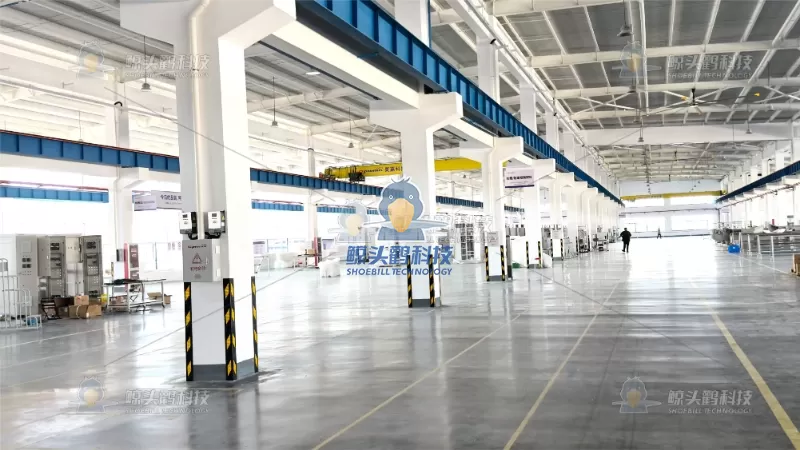
Shoebill Technology carefully considers these spatial dynamics. For example, compressed air rooms are located adjacent to production lines, connected via pipelines designed for rapid air delivery. Similarly, cooling water stations are situated to support both industrial processes and HVAC systems efficiently, while maintaining isolation from critical production areas to prevent potential interference. This dual approach of accessibility and segregation ensures operational safety and efficiency.
Modular Design and Equipment Standardization
Modularity is a key principle in smart factory auxiliary facility planning. Standardized units for power distribution, compressed air, water treatment, and cooling systems allow for flexible reconfiguration as production requirements evolve. Shoebill Technology advocates for a modular design philosophy, enabling factories to expand or repurpose auxiliary spaces with minimal disruption to ongoing operations.
Standardization extends to equipment selection as well. Uniform specifications for pumps, compressors, chillers, and electrical panels simplify maintenance and spare parts management. This approach reduces downtime caused by equipment failure and streamlines the operational lifecycle of auxiliary facilities, contributing to overall production reliability.
Environmental Compliance and Risk Mitigation
In the context of a smart factory layout, auxiliary facilities play a crucial role in environmental management and regulatory compliance. Facilities handling hazardous chemicals, wastewater, or high-energy systems must adhere to stringent safety and environmental standards. Proper planning ensures that these units operate in compliance with local regulations while maintaining the safety of both personnel and surrounding communities.
Shoebill Technology incorporates risk assessment into auxiliary facility planning. By analyzing potential hazards, including fire, chemical spills, and equipment malfunctions, engineers design containment measures, emergency response systems, and monitoring protocols. This proactive approach not only safeguards the workforce but also protects production continuity and factory reputation.
Integrated Automation and Smart Monitoring
A modern smart factory layout benefits significantly from the integration of automation and monitoring systems within auxiliary facilities. Sensors for energy consumption, water flow, air pressure, and temperature allow real-time data collection, enabling predictive maintenance and proactive adjustments. Shoebill Technology implements intelligent monitoring networks that connect auxiliary facilities to central control systems, ensuring quick response to anomalies and optimal resource allocation.
Automation within auxiliary spaces also enhances production efficiency. For example, automated pressure regulation in compressed air rooms prevents fluctuations that could disrupt production lines. Similarly, smart cooling systems adjust thermal output based on real-time load, reducing energy waste and extending equipment lifespan.
Distance and Flow Optimization
Maintaining appropriate distances between auxiliary facilities and production zones is critical in a smart factory layout. Facilities should be close enough to provide efficient support but sufficiently separated to avoid interference with operations. Shoebill Technology emphasizes optimized flow design, ensuring that resources such as electricity, water, and compressed air reach production areas quickly and reliably without causing noise, vibration, or thermal disruption.
In practice, this may involve positioning compressed air rooms around the production perimeter with direct pipeline connections or situating cooling water tanks to leverage gravity flow while maintaining isolation from sensitive machinery. Such considerations ensure continuous production support while minimizing operational risk.
Maintenance and Lifecycle Management
Effective auxiliary facility planning also includes long-term maintenance strategies within the smart factory layout. Shoebill Technology integrates accessible layouts, modular equipment, and predictive monitoring to streamline maintenance routines. Regular inspections, combined with real-time performance analytics, enable proactive repairs and reduce the likelihood of sudden equipment failures.
This lifecycle-oriented planning results in measurable performance improvements. In one industrial park, strategic auxiliary facility placement and monitoring reduced equipment failure rates by approximately 30%, illustrating the tangible benefits of systematic planning.
Coordination with Production Expansion
Auxiliary facilities must not only support current operations but also anticipate future production expansions. A forward-thinking smart factory layout considers scalability in utility provision, space allocation, and modular system design. Shoebill Technology ensures that auxiliary infrastructure can be easily upgraded or expanded to accommodate new production lines, increased throughput, or additional regulatory requirements without extensive retrofitting.
This proactive approach reduces downtime and capital expenditure, allowing factories to respond dynamically to market demands while maintaining consistent production quality.
Holistic Integration with Digital Twins
Digital twin technology offers a new dimension for smart factory layout optimization, particularly in auxiliary facility planning. By creating virtual replicas of factory infrastructure, engineers can simulate energy flow, resource utilization, and operational scenarios for auxiliary systems. Shoebill Technology leverages this tool to identify bottlenecks, optimize space utilization, and forecast maintenance needs, ensuring that auxiliary facilities contribute maximally to overall factory efficiency.
Digital twin integration supports data-driven decision-making, allowing factories to continually refine auxiliary facility placement, capacity planning, and system interactions for both operational and environmental performance.
Conclusion
Auxiliary facilities are indispensable to the performance, safety, and sustainability of a smart factory layout. From energy distribution to environmental compliance, spatial planning, modular design, and automated monitoring, every element contributes to seamless production support. Shoebill Technology’s comprehensive approach—quantifying resource needs, optimizing facility placement, implementing standardized equipment, and integrating intelligent monitoring—demonstrates the strategic value of meticulous auxiliary planning.
Factories that invest in such holistic design experience measurable benefits, including reduced equipment failure rates, improved operational efficiency, and enhanced scalability for future production expansion. In a highly competitive industrial environment, the strategic layout and management of auxiliary facilities distinguish a truly smart factory from one that merely functions.
By prioritizing auxiliary spaces as core components of the smart factory layout, enterprises can ensure resilient production, sustainable operations, and long-term competitiveness, setting a benchmark for next-generation industrial planning.