
Nov 13, 2025
Multi-Dimensional Iteration and Optimization in Industrial Park Master Planning
In regions like Jiangsu, Zhejiang, and Shanghai, where land resources are increasingly limited, small and medium-sized factories face the challenge of maximizing their workshop space without expanding their physical footprint. Shoebill Technology has addressed this challenge with its innovative mezzanine design approach, providing a strategic solution for industrial space planning. By introducing mezzanine levels inside workshops, factories can relocate indirect production functions—such as office areas, meeting rooms, changing facilities, and storage—to elevated platforms, freeing up primary floor space for core manufacturing processes. This approach has proven to enhance space utilization by over 30%, while maintaining operational efficiency. In this blog post, Shoebill Technology, a professional manufacturing workshop layout service provider, will share mezzanine design and three-dimensional expansion of layout for workshop space.
A mezzanine is an intermediate floor installed within a high-ceilinged workshop, designed to accommodate functions that do not require direct involvement in production. Shoebill Technology’s layout for workshop space concept leverages the vertical dimension of factory buildings, converting previously underutilized air space into functional areas. This transformation allows manufacturers to:
Separate administrative and production functions without disrupting workflows.
Create dedicated zones for storage and logistics, enhancing operational flow.
Increase core production capacity by freeing up floor space for machinery and assembly lines.
For instance, in a lightweight manufacturing plant with a main hall height of 16.5 meters, Shoebill Technology implemented a mezzanine level at 3.9 meters. This new floor accommodates offices, meeting rooms, changing rooms, and auxiliary material storage, while the main floor focuses solely on melting, die-casting, and machining operations. The result: a 35% increase in usable space compared to traditional single-level layouts.
Shoebill Technology designs mezzanine layouts based on both workshop height and operational requirements. Each zone is strategically positioned to maximize accessibility and efficiency. The six core functional areas commonly included are:
Workshop Offices
The mezzanine office serves as the hub of production management. Positioned above the production floor, it allows supervisors and managers to monitor operations in real time while providing a quiet environment for administrative tasks.
Meeting Rooms
Daily coordination, team briefings, and cross-departmental meetings are conducted in mezzanine meeting rooms. By relocating these spaces above the production floor, disruptions to the manufacturing workflow are minimized.
Changing Rooms
Conveniently located near workshop entrances, changing rooms allow employees to store personal items and change into work attire efficiently. This placement supports workflow continuity and reduces congestion on the main floor.
Auxiliary Material Storage
Mezzanine storage areas for secondary materials and consumables enable rapid supply to production lines, reducing downtime and improving efficiency.
Spare Parts and Equipment Storage
A dedicated mezzanine area for equipment spares and pre-prepared materials ensures fast response for maintenance needs and prevents interruptions in production.
Cafeteria and Break Areas
Integrating employee dining areas into the mezzanine avoids the need for separate buildings, optimizing land usage while maintaining comfort and convenience.
By grouping these functions in an elevated zone, the main workshop floor remains uncluttered and focused on core manufacturing processes, significantly enhancing productivity and safety.
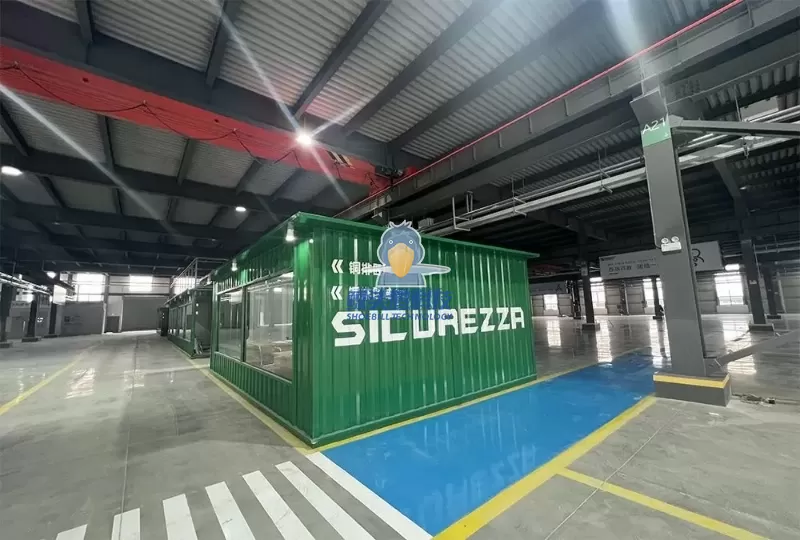
A critical aspect of mezzanine design is structural integrity. Shoebill Technology employs steel frame construction for mezzanines, with a load capacity of 0.25 tons per square meter. This ensures safety for both personnel and stored materials. The steel structure can support offices, storage racks, and light furniture while maintaining overall stability.
Moreover, height optimization is crucial. Taller workshops allow for multiple mezzanine levels or higher ceilings, providing flexibility in zoning. In workshops with a 16.5-meter ceiling, a 3.9-meter mezzanine height provides sufficient clearance for office and storage areas while leaving ample vertical space for production machinery on the main floor.
Shoebill Technology’s mezzanine approach delivers multiple benefits:
Maximized Land Use: In high-cost regions with limited land, vertical expansion is often more feasible than horizontal growth.
Operational Efficiency: By separating administrative and indirect production functions from manufacturing areas, workflow interruptions are minimized.
Cost-Effectiveness: Mezzanine construction is faster and more affordable than building additional floors or renting separate office spaces.
Flexibility: Mezzanine spaces can be adapted or reconfigured as production needs evolve, providing long-term operational resilience.
Enhanced Safety: Organized separation of functional zones reduces hazards associated with cluttered workshops.
In a lightweight manufacturing facility, Shoebill Technology implemented a 3.9-meter-high mezzanine in a 16.5-meter high workshop. Key outcomes included:
Relocation of office, meeting, changing, and auxiliary storage spaces to the mezzanine.
Main floor dedicated to melting, die-casting, and machining.
Achieved a 35% increase in usable floor space.
Optimized workflow by minimizing cross-traffic between administrative and production areas.
The project demonstrated how thoughtful layout for workshop space planning could transform underutilized areas into fully functional zones without compromising production efficiency.
When designing mezzanine solutions, it is important to consider:
Load-bearing requirements based on intended use. Offices, storage, and dining areas have different load demands.
Accessibility and circulation: Stairways, lifts, or mezzanine ramps must facilitate smooth movement for staff and materials.
Compliance with safety regulations: Fire exits, guardrails, and emergency evacuation plans must be integrated.
Integration with utilities: Lighting, HVAC, and electrical wiring must accommodate the elevated structure without affecting production below.
These factors ensure the mezzanine is not only functional but also sustainable for long-term operations.
The industrial sector is increasingly recognizing the value of three-dimensional layout for workshop space. Mezzanine solutions, like those offered by Shoebill Technology, present a scalable model for maximizing factory efficiency while responding to land constraints. By elevating non-production functions, factories can achieve higher productivity, better workflow organization, and improved employee experience—all within the same footprint.
Additionally, advances in modular steel construction and mezzanine design software allow for rapid customization, enabling factories to adapt their layout to evolving production requirements. As land scarcity persists in urbanized regions, vertical expansion through mezzanine design is likely to become an industry standard.
Shoebill Technology’s mezzanine approach exemplifies innovative industrial space utilization. By focusing on vertical expansion, strategic zoning, and efficient layout for workshop space, small and medium-sized factories can overcome land limitations while enhancing productivity, safety, and operational flexibility. Mezzanine design transforms underutilized workshop air space into multifunctional zones, freeing the main floor for core manufacturing operations and achieving a significant increase in usable space.
For factories in Jiangsu, Zhejiang, Shanghai, and other land-constrained regions, embracing mezzanine layouts is not just an option—it is a necessity for sustainable growth and efficient industrial operations.

Add: Room 501, Building 1, Lane 668, Defu Road,Jiading District,Shanghai, China
Tel: 021-61354399
Contact: Mr. Chen