
Nov 10, 2025
Smart Integration of Logistics Warehouse Planning and Inventory Optimization
In modern manufacturing systems, efficiency is no longer determined only by equipment capability or digital platforms. Increasingly, it is shaped by how management is physically embedded into production environments. Container office area planning, when integrated with on-site management practices, represents a structural innovation that reshapes daily factory operations.
In this blog post, Shoebill Technology, a professional lean factory design service provider, will share an innovative integration of containerized office space planning and on-site management. By introducing containerized office areas into smart factory planning, management functions are directly located alongside the production line. This approach transforms spatial layout into a management tool, closely linking decision-making with actual workshop conditions and significantly accelerating response times. Management is no longer detached from operations but becomes an active participant in the production process.
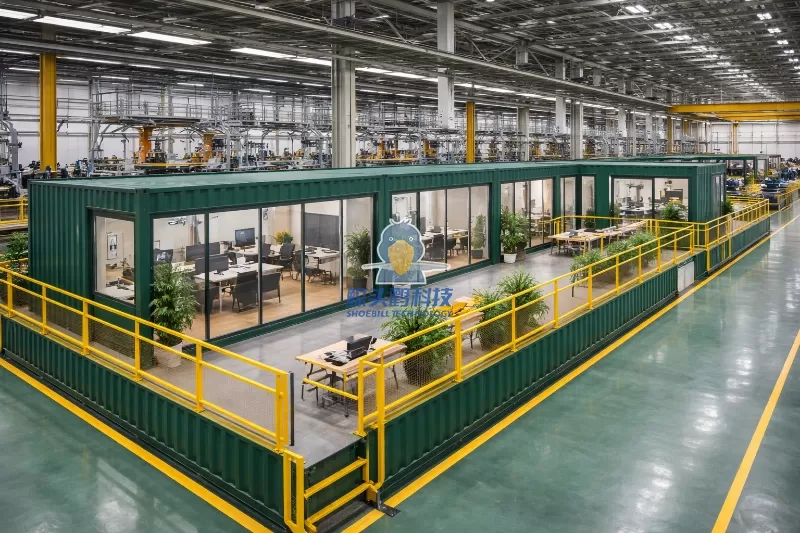
Container office area planning redefines the role of office space within industrial facilities. Instead of locating offices in separate buildings, modular container units are deployed inside production areas as integrated management zones. These offices are planned as part of the overall factory system rather than as independent structures.
Shoebill Technology incorporates container office areas during early-stage factory layout design. Office placement follows production logic, line supervision needs, and material flow, ensuring that management activities support operational priorities. As a result, the container office area functions as an extension of the production system rather than an isolated administrative space.
Effective on-site management depends on immediacy, accuracy, and direct observation. When managers work close to production lines, they can verify conditions directly and respond based on actual situations rather than delayed information. Container office planning eliminates unnecessary physical separation between management and operations.
Transparent glass walls are a key design element, allowing continuous visual access to production processes. Managers can observe workflow changes, detect abnormalities, and confirm improvements in real time. This reinforces disciplined management based on facts and direct observation instead of assumptions or reports alone.
Flexibility is essential in smart factory environments. Container office areas meet this requirement through modular design principles. Shoebill Technology uses standardized green container units that can be assembled, expanded, or relocated as production layouts evolve.
Yellow safety fencing and continuous lighting strips connect individual container modules into a unified office zone. This creates clear spatial boundaries while maintaining openness and accessibility. Such modular layouts support phased factory development, allowing management spaces to adapt alongside production capacity changes without disrupting operations.
Visibility is a core requirement for effective on-site management. Container office planning prioritizes clear lines of sight across production areas through transparent façades and strategic positioning. Managers can monitor production status, operator activities, and material movement directly from the office area.
Interior layouts are intentionally simple and functional. Basic desks, chairs, and minimal furnishings support focused management work, while indoor plants improve comfort without distracting from operational oversight. The objective is not to replicate a traditional office environment, but to create a practical management base tightly connected to production realities.
Daily production management relies on frequent communication and alignment. Container office areas integrate dedicated meeting zones for shift briefings, daily production coordination, and scheduling discussions. These zones are located adjacent to production lines, ensuring that discussions are grounded in real operating conditions.
Holding meetings within the production environment shortens communication paths and reduces misunderstandings. Issues raised during discussions can be verified immediately, and corrective actions can be implemented without delay. This strengthens execution discipline and closes the gap between planning and action.
One of the most direct benefits of integrating container office planning with on-site management is the reduction of response time. Physical proximity enables immediate action when problems occur. Managers can leave the container office and reach the affected area within minutes.
In a Shoebill Technology project near an assembly line, supervisors working from the container office area continuously monitored production progress. When abnormalities appeared, response time was reduced from approximately 30 minutes to 5 minutes. This improvement was achieved through layout optimization rather than additional digital systems, demonstrating the operational impact of spatial design.
Visible management presence influences both behavior and culture. Container office areas located within production zones signal that management is directly involved in daily operations. This presence encourages faster communication and proactive problem reporting.
Employees working near container office areas interact more frequently with supervisors and team leaders. Questions and issues are addressed informally and promptly, reducing delays and preventing small problems from escalating. The physical layout supports a collaborative and responsive working environment.
Container office areas also function as carriers of organizational culture. Shoebill Technology integrates visual displays on office walls that communicate collaborative governance concepts, standard work principles, and shared responsibility values.
By embedding cultural messages directly into the on-site office environment, management principles become part of daily observation rather than abstract statements. This reinforces consistent behavior and aligns teams around common operational objectives without relying solely on formal training programs.
From an investment perspective, container office area planning offers clear advantages. Modular container construction reduces build time compared to traditional office buildings and allows capital to be allocated more efficiently. At the same time, functionality and appearance are maintained.
Uniform container design, coordinated color schemes, and integrated lighting enhance the overall factory image. Rather than appearing temporary, container office areas contribute to a structured, modern workshop environment that reflects disciplined management standards.
Factory layout influences how employees perceive management intent. When managers work close to production lines, employees feel supported rather than monitored. Container office areas reduce hierarchical distance and promote mutual understanding between management and operators.
Customer feedback indicates that after container office areas were introduced, employee satisfaction improved alongside operational performance. Faster issue resolution and transparent communication created a sense of shared ownership over production outcomes, strengthening engagement across teams.
The effectiveness of combining container office area planning with on-site management is reflected in measurable performance outcomes. One Shoebill Technology customer reported a 70 percent improvement in efficiency when handling production abnormalities after implementing container office areas.
These results demonstrate that spatial planning decisions can directly influence management effectiveness. Aligning office location with production reality creates faster feedback loops, stronger execution, and more consistent daily management practices.
As smart factories continue to evolve, the integration of physical layout and management philosophy will become increasingly important. Container office area planning provides a practical framework for embedding management directly into production environments while maintaining flexibility and efficiency.
Shoebill Technology’s approach shows that innovation in factory planning is not limited to automation or digitalization. By rethinking where and how management operates, container office areas transform the shop floor into a space where observation, decision-making, and execution are seamlessly connected. This integrated model offers a clear direction for factories seeking sustainable improvements in on-site management performance.

Add: Room 501, Building 1, Lane 668, Defu Road,Jiading District,Shanghai, China
Tel: 021-61354399
Contact: Mr. Chen