
Dec 08, 2025
Marketing-Oriented Factory Planning for Maximizing Brand Value
Building a new factory is no longer just a construction project—it is a strategic decision that determines long-term competitiveness, cost structure, and operational resilience. In recent years, factory planning layout has become a critical topic for manufacturers seeking digitalization, efficiency, and scalability. However, many new factory projects still fall into predictable traps, resulting in wasted investment, repeated renovations, and underperforming operations. In this blog post, as professional lean factory design service exporter, Shoebill Technology will share a guide to avoiding pitfalls and building a scientific process for smart new factory planning and layout.
Many factory projects encounter problems not because of poor execution, but because of flawed early-stage decisions. In smart new factory planning layout, mistakes made during the planning phase are often irreversible or extremely costly to correct later.
Three recurring misconceptions stand out:
Selection trap: Directly hiring a design institute without prior systematic planning
Timing trap: Starting layout planning only when relocation or construction is imminent
Improvement trap: Replicating old factory layouts under the guise of “smart upgrading”
These issues share a common root cause: the absence of a structured planning framework that aligns factory layout with business strategy, production logic, and future development.
A factory layout is not merely about arranging buildings and equipment. A well-executed smart new factory planning layout acts as a physical expression of corporate strategy.
At a strategic level, factory planning determines:
Whether capacity expansion can occur without disrupting operations
Whether automation and digital systems can be integrated smoothly
Whether logistics flows support lean and low-cost operations
Whether management efficiency improves or deteriorates with scale
Without a forward-looking layout, even advanced equipment and digital systems may fail to deliver expected returns.
Design institutes excel at architectural compliance and engineering drawings, but they are rarely responsible for operational efficiency. When enterprises skip the planning stage and move directly to design, smart new factory planning layout becomes reactive rather than strategic.
Late-stage planning forces layout decisions to adapt to fixed constraints such as land boundaries, building structures, or equipment orders. This limits optimization space and compromises logistics efficiency.
Many companies assume that a “proven” old factory layout can simply be scaled up. In reality, changes in product mix, automation level, workforce structure, and logistics models require fundamentally different planning logic.
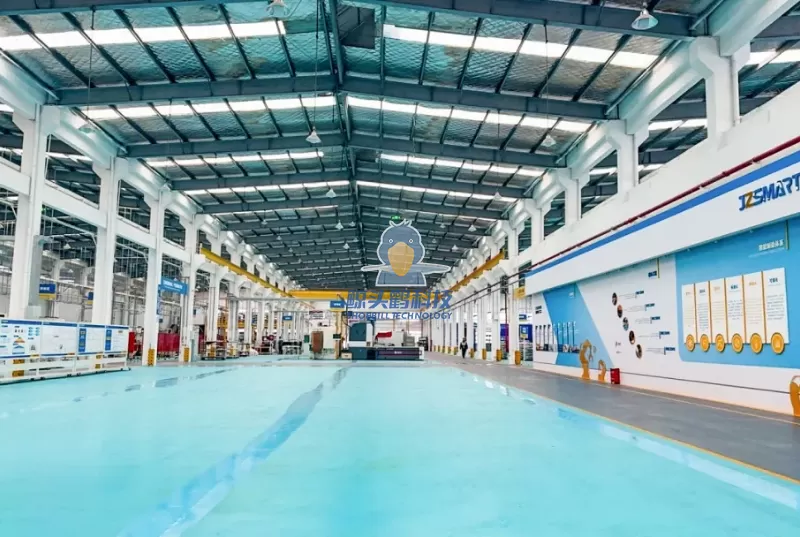
Effective factory planning is not a single design task, but a progressive decision-making process. Shoebill Technology addresses this by implementing a six-step standardized planning framework, transforming smart new factory planning layout from an experience-driven activity into a data-driven system.
This process ensures that layout decisions are justified, verifiable, and aligned with long-term objectives.
The first step focuses on clarifying the overall planning intent before any drawings are produced. Key questions include:
What is the target production capacity over 5–10 years?
What functional zones are required (manufacturing, warehousing, R&D, offices)?
What level of automation and intelligence is expected?
By defining these parameters early, smart new factory planning layout avoids directional errors that later force costly redesigns.
Every factory site has unique constraints. This step ensures that planning decisions are grounded in reality rather than assumptions.
Critical considerations include:
Land area, shape, and expansion potential
Road access and internal traffic organization
Environmental regulations and compliance boundaries
In smart factory layout planning, compliance is not a limitation—it is a boundary condition that shapes efficient design.
A smart layout cannot exist without accurate data. This stage involves detailed calculations of:
Equipment quantity and footprint
Workforce size and shift patterns
Utility demand such as power, water, and compressed air
By converting operational needs into quantifiable inputs, smart new factory planning layout becomes measurable and controllable.
At this stage, enterprises must make strategic choices that define the factory’s character. Options may include:
Lean production-oriented layouts
Intelligent logistics-driven configurations
Low-carbon or near-zero-emission industrial parks
This step ensures that the smart factory layout is not generic, but purpose-built to support a clear operational philosophy.
With strategy and data in place, layout design can begin. Instead of a single solution, multiple planning schemes are developed and evaluated.
Key focuses include:
Material flow continuity
Separation and interaction of people, vehicles, and goods
Expandability without disrupting existing operations
This multi-scheme approach ensures that smart new factory planning layout balances current practicality with future adaptability.
The final step compares alternative layouts using objective criteria rather than subjective preference. Evaluation dimensions typically include:
Logistics distance and handling efficiency
Workforce movement and safety
Management visibility and control efficiency
Through systematic comparison, enterprises can select the optimal smart new factory planning layout with confidence.
One manufacturing enterprise initially planned to engage a design institute directly for its new factory. After consulting Shoebill Technology, the company adopted the six-step planning process instead.
As a result:
Inefficient building area allocation was avoided
Utility routing issues were identified before construction
No secondary renovation was required after commissioning
After completion, the new factory achieved a 60% productivity increase compared with the old plant, demonstrating how structured smart new factory planning layout delivers tangible outcomes.
Traditional factory projects often react to constraints. In contrast, scientific planning transforms constraints into design inputs. The Shoebill Technology methodology shifts smart new factory planning layout from a passive design exercise to a proactive strategic process.
This approach ensures that the factory evolves alongside business growth rather than becoming a bottleneck.
A new factory is a long-term asset that should serve enterprise strategy for decades. Smart planning is not about adding more technology—it is about building the right logic from the beginning.
By avoiding common misconceptions, adopting a structured planning framework, and grounding decisions in data and strategy, smart new factory planning layout becomes a powerful tool for sustainable industrial development.

Add: Room 501, Building 1, Lane 668, Defu Road,Jiading District,Shanghai, China
Tel: 021-61354399
Contact: Mr. Chen