
Sep 15, 2025
Smart Factory Planning and Plant Layout for Future Manufacturing
Workshop planning layout plays a decisive role in industries where manufacturing quality is tightly linked to environmental control. Sectors such as electronics, pharmaceuticals, and precision engineering rely on dust-free rooms with stringent classifications to safeguard sensitive processes. Shoebill Technology has developed a rigorous methodology for planning cleanroom workshops, ensuring that each facility is engineered to meet requirements ranging from ISO Class 8 (100,000-level) to even more demanding cleanliness standards.
A scientifically designed workshop layout is not simply about arranging spaces. It integrates airflow engineering, environmental stability, pressure differentials, personnel protocols, and material flow control into a unified system. In this blog post, Shoebill Technology, as professional lean production layout service provider, will share the features of workshop planning layout for high-cleanroom manufacturing.
In modern precision manufacturing, the workshop planning layout must be derived from the target cleanliness level and operational conditions. Shoebill Technology begins each project by defining the required cleanroom class for specific production zones. For example, an electronic IBC assembly line may mandate a 100,000-level dust-free environment with strict temperature and humidity control.
Once the cleanliness class is confirmed, the layout design integrates multi-stage air purification. This typically includes primary filters to capture large particulates, medium-efficiency filters for finer dust, and high-efficiency particulate air (HEPA) filters to ensure compliance with the defined class. The configuration of these filtration stages directly influences the airflow organization within the workshop.
Shoebill Technology selects either vertical laminar flow or horizontal air distribution depending on equipment arrangement, process sensitivity, and heat load distribution. Vertical laminar flow is ideal for areas with ultra-sensitive operations, ensuring airflow moves contaminants downward and away from work surfaces. Horizontal flow is applied where equipment layout requires lateral air sweeping to maintain particle removal efficiency.
A critical element of workshop planning layout is the segmentation of cleanroom zones according to contamination risk and process priority. Shoebill Technology divides the facility into three primary areas:
Core Production Zones – where precision operations occur and the strictest cleanliness level is maintained.
Auxiliary Areas – including gowning rooms, buffer rooms, cleaning spaces, and equipment maintenance zones.
Logistics Interfaces – such as material transfer rooms and air-shower sections.
Personnel access procedures are meticulously planned to prevent contamination spikes. In typical cleanroom workflow, operators pass through multi-stage entry points involving gowning, handwashing, and air showers. For example, in a line-control assembly workshop, Shoebill Technology designs a dedicated multi-stage gowning buffer to ensure all staff undergo complete decontamination before entering the main production area.
The movement of materials is equally controlled. Material transfer windows, equipped with disinfection modules, allow components to enter the cleanroom without requiring personnel to open direct pathways. Some facilities employ automated pass-through windows and conveyors, which Shoebill Technology integrates into the workshop planning layout to prevent cross-contamination between internal and external spaces.
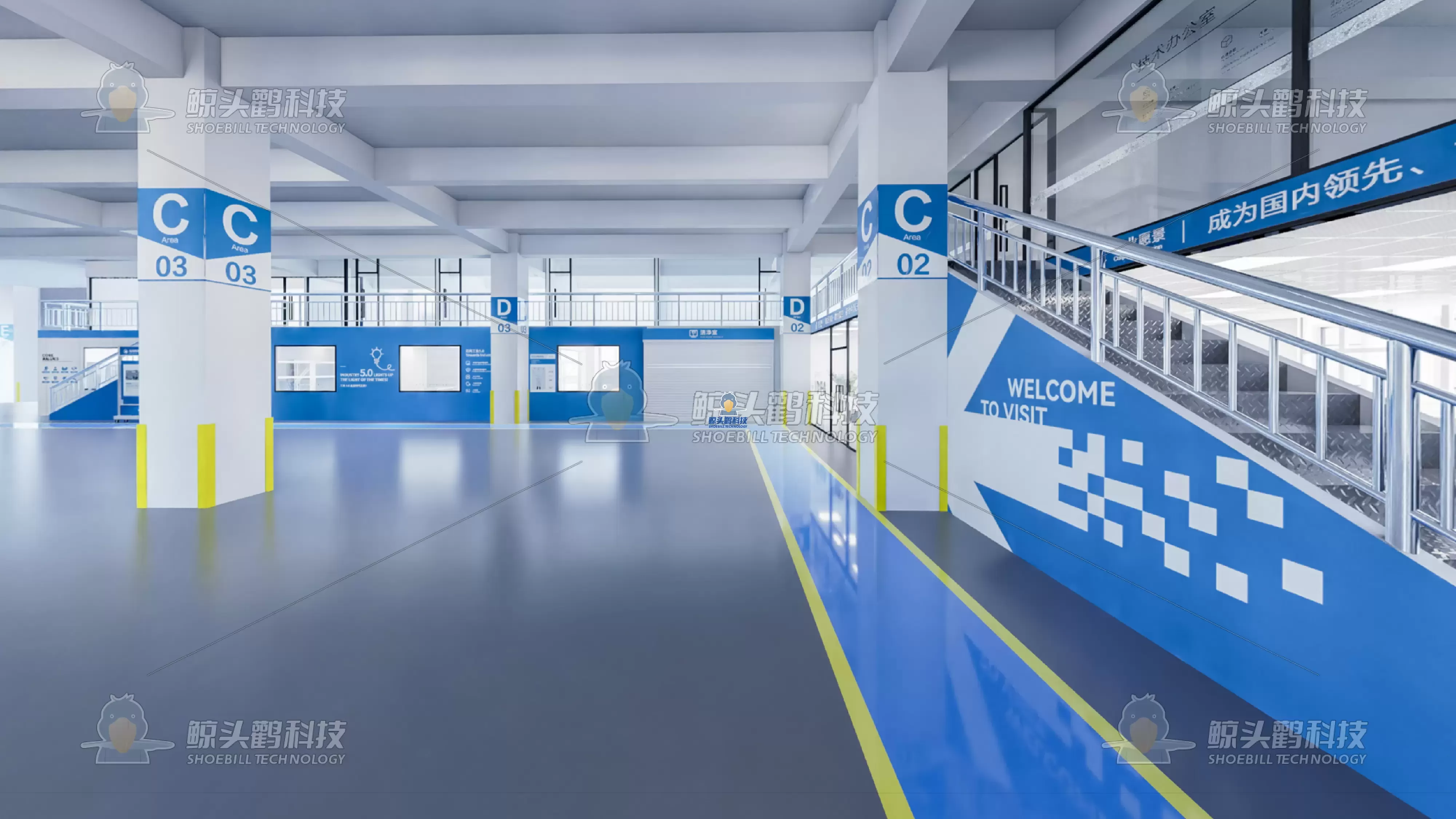
A modern cleanroom layout must not only achieve initial compliance but must maintain stability through continuous monitoring. Shoebill Technology incorporates environmental monitoring infrastructure at the planning stage rather than as an add-on. Sensors for temperature, humidity, differential pressure, and particle count are strategically positioned based on airflow dynamics and process locations.
These sensors feed real-time data to smart-factory management platforms. This integrated system allows operators to track deviations quickly, schedule predictive maintenance, and ensure that conditions remain within their defined windows. Stable environmental control is essential for processes like pharmaceutical formulation or microelectronics assembly, where even minor fluctuations can damage product integrity.
Additionally, Shoebill Technology evaluates heat loads generated by machinery and arranges HVAC and cooling systems accordingly. This ensures that the workshop planning layout aligns thermal management with airflow design, preventing localized turbulence or temperature gradients.
In industries where clients or partners frequently inspect manufacturing sites, the workshop must allow observation without compromising cleanliness. Shoebill Technology addresses this by integrating dedicated visitor corridors into the workshop planning layout. These corridors are separated by specialized viewing windows that prevent airflow disturbance while providing clear visibility of critical processes.
Such design offers two advantages:
It supports customer transparency and confidence in manufacturing quality.
It prevents contamination associated with visitor flow inside controlled zones.
The inclusion of these pathways demonstrates the thoroughness with which Shoebill Technology plans precision-manufacturing environments, balancing operational efficiency with external engagement requirements.
Another dimension of workshop planning layout is long-term adaptability. Precision manufacturing evolves rapidly, and cleanrooms must accommodate equipment upgrades, expanded production lines, or shifts in process parameters. Shoebill Technology uses modular planning concepts, enabling partitions, air systems, and monitoring interfaces to be upgraded without disrupting the entire facility.
Key modular planning elements include:
Reconfigurable zoning panels
Scalable air purification systems
Expandable HVAC capacity
Flexible material flow channels
Adaptable monitoring system architecture
With modular design, manufacturers can respond to new technologies or capacity demands while maintaining continuous operation, a crucial advantage in competitive industries.
A workshop layout has direct impact on production stability, contamination control, operational workflow efficiency, equipment reliability, and ultimately product yield. Shoebill Technology’s cleanroom planning approach is characterized by its depth, accuracy, and holistic perspective. By integrating purification, monitoring, zoning, personnel control, and logistics considerations into a single cohesive design, the company ensures that dust-free workshops meet the rigorous needs of advanced manufacturing.
From electronics to biopharmaceuticals to high-precision assembly, the workshop planning layout is more than a spatial arrangement—it is an engineering system that defines the quality baseline of the entire production ecosystem. Shoebill Technology’s systematic methodology underscores the strategic importance of scientifically designed dust-free facilities and reinforces its role as a trusted partner for precision-environment manufacturing.

Add: Room 501, Building 1, Lane 668, Defu Road,Jiading District,Shanghai, China
Tel: 021-61354399
Contact: Mr. Chen