
Dec 15, 2025
From Common Planning Traps to Structured New Factory Blueprint
Smart manufacturing continues to redefine industrial competitiveness, and factory layout planning has become one of the most decisive elements in building an efficient, flexible, and collaborative production environment. Among the many layout strategies emerging in modern industrial design, the U-shaped configuration stands out for its ability to strengthen process coordination, shorten material flow, and seamlessly integrate production and management functions. In this blog post, Shoebill Technology, as professional lean factory layout service provider, will share insights on U-shaped smart manufacturing factory layout for high efficiency operation.
A well-designed smart manufacturing factory layout is more than an arrangement of equipment; it is a structural foundation that determines how information, materials, and personnel interact throughout the production cycle. As manufacturing moves toward automation, real-time data interaction, and cross-department collaboration, the spatial configuration must support:
Streamlined process flow
High-frequency coordination among departments
Direct linkage between digital monitoring and physical production
Scalable pathways for automation and robotics
Shoebill Technology’s U-shaped layout is engineered precisely to meet these emerging requirements, integrating physical space with digital intelligence for seamless manufacturing execution.
The U-shaped factory layout represents an optimized approach to synchronizing production sequences while enabling teams across functions to maintain close operational connectivity. In Shoebill Technology’s implementation, stamping, multi-station operations, and mold processing units are arranged along a U-shaped trajectory. This creates a continuous, circular flow where materials move through each production stage without unnecessary detours or intersection points.
Such a configuration results in:
Closed-loop process flow, where workpieces travel efficiently from start to finish
Shortened logistics routes, which reduce internal transport time and boost response speed
Improved workplace visibility, allowing management to monitor process status and equipment conditions more effectively
This U-shaped arrangement not only supports smart production systems but also builds a natural structure for implementing real-time monitoring, automated material handling, and digital scheduling systems commonly found in advanced smart manufacturing plants.
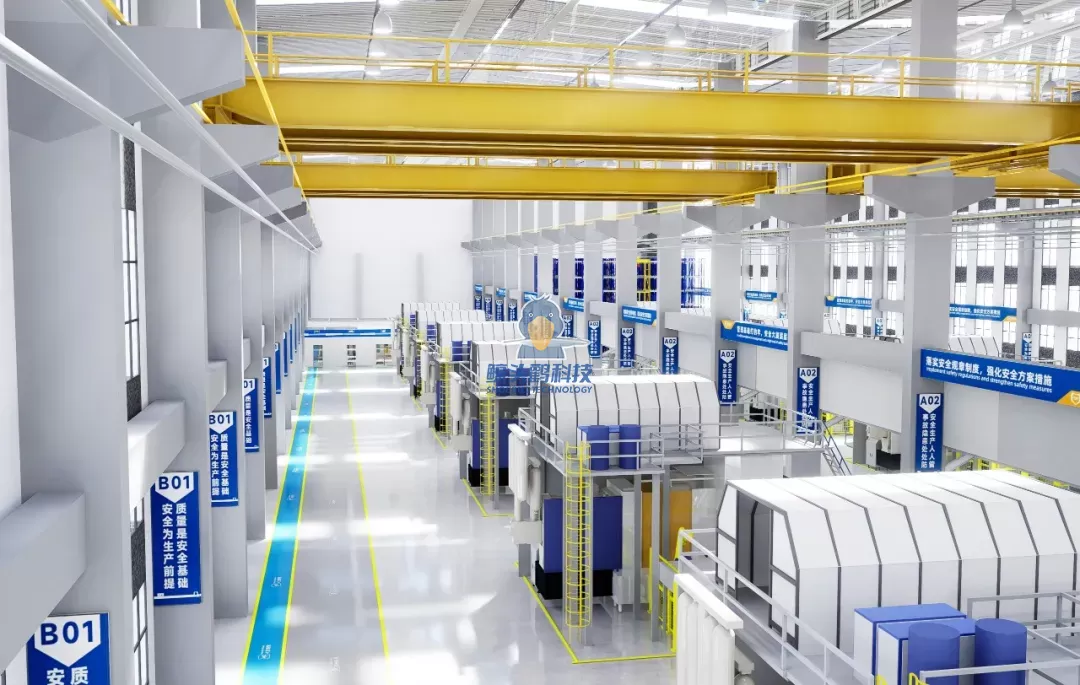
A distinguishing feature of Shoebill Technology’s planning is the vertical integration of production and office functions, a key element in modern smart factory layout planning. While many factories separate administrative areas horizontally across different buildings, Shoebill’s U-shaped plant design positions office spaces directly above production floors.
For example, in a Zhejiang-based manufacturing facility built with this concept:
Floors 1–2 house production zones such as stamping, welding, and assembly, arranged according to process sequence.
Floor 3 contains open offices, R&D laboratories, and multifunctional conference rooms.
This structure allows:
Rapid access from management to the production line
Faster troubleshooting and decision-making
Immediate validation of new R&D outcomes on the shop floor
Shortened communication loops between engineering, quality control, and production teams
In a smart manufacturing environment where real-time coordination is critical, this vertical integration reduces latency in both information flow and operational response.
Material handling efficiency is a central pillar of any smart manufacturing layout design, and the U-shaped factory structure significantly strengthens this aspect. By forming a ring-shaped logistics route, the layout minimizes forklift travel distance, reduces material congestion, and prevents the cross-traffic issues that commonly appear in linear production layouts.
Shoebill Technology reports that this circular route improves internal logistics efficiency by over 40%, an outcome driven by:
Clear separation of inbound and outbound material paths
Less spatial interference between different processes
Predictable and automated scheduling possibilities for AGVs and AMRs
More stable takt time across multi-step production processes
With reduced variability in movement and timing, automation technologies—essential elements of a smart manufacturing ecosystem—are also easier to integrate.
Smart factory planning is incomplete without considering employee well-being and operational independence of support facilities. Shoebill Technology extends its layout philosophy by arranging dormitories, canteens, and supporting amenities along the outside of the U-shaped plant.
Key benefits include:
Maintaining a suitable distance between living areas and production zones
Ensuring that daily activities do not disrupt manufacturing operations
Providing convenient access for employees without interfering with logistics routes
Supporting healthy work-life balance, which aligns with modern industrial workplace standards
This approach enhances the overall sustainability and human-centric nature of the factory, an increasingly relevant aspect in contemporary manufacturing design.
The U-shaped layout adopted by Shoebill Technology demonstrates how smart manufacturing factory layout can evolve from traditional linear concepts to integrated, data-ready structures that optimize collaboration, efficiency, and responsiveness. As manufacturing industries continue to embrace automation, AI-driven decision support, and cyber-physical systems, factory layout will no longer remain a one-time architectural decision but an adaptable framework supporting continuous improvement.
Shoebill’s approach exemplifies the potential of layout innovation to:
Strengthen inter-department synergy
Enable quicker escalation and resolution of production issues
Support high-mix, multi-process manufacturing scenarios
Align with digital transformation paths in modern industrial operations
By creating a harmonious connection between production, management, R&D, and employee support facilities, the U-shaped configuration serves as a blueprint for future smart factories aiming for high agility and operational intelligence.

Add: Room 501, Building 1, Lane 668, Defu Road,Jiading District,Shanghai, China
Tel: 021-61354399
Contact: Mr. Chen