
Jan 22, 2026
Smart Factory Logistics-Driven Manufacturing Workshop Layout Optimization
In today’s manufacturing landscape, a workshop is no longer just a production space. It has become a comprehensive reflection of a company’s technical capability, management philosophy, and long-term competitiveness. With growing emphasis on transparency, efficiency, and collaboration, smart workshop planning is increasingly used not only to improve internal operations but also to serve as a powerful demonstration platform for customers and partners.
Shoebill Technology has successfully delivered multiple intelligent workshop showcase projects that are widely praised by clients. These smart workshops achieve measurable improvements in productivity and quality while also functioning as high-impact demonstration sites that strengthen customer confidence and attract new cooperation opportunities. The success of these projects lies in a systematic planning approach built around four core dimensions: spatial environment, production layout, human–machine collaboration, and management philosophy. In this blog post, Shoebill Technology, as professional efficient workshop layout services provider, will share the the logic and implementation of smart sample workshop planning.
The first impression of a smart workshop is created by its spatial environment. In Shoebill Technology’s smart workshop planning methodology, space is treated as an operational resource rather than a static shell.
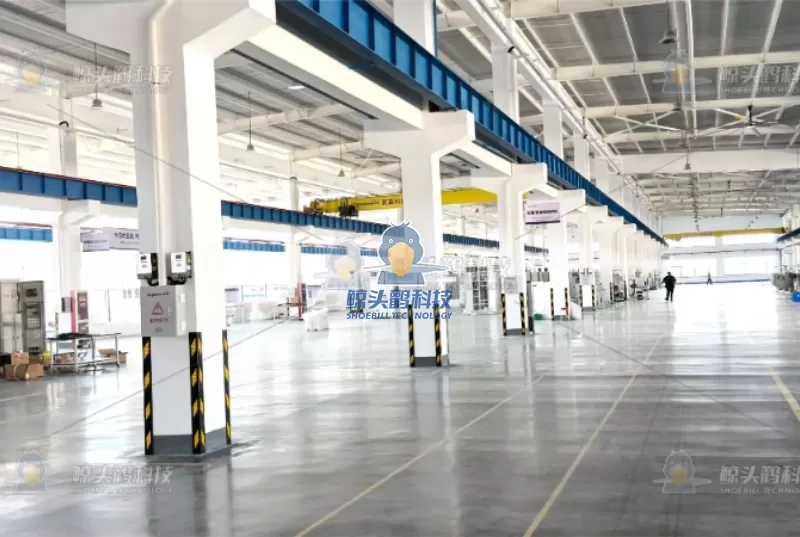
Showcase workshops are designed with open, bright halls that immediately convey a sense of order and professionalism. Clear directional signage and electronic display screens guide visitors through the workshop, while also providing real-time production information. This combination supports both operational clarity and external communication.
Within production areas, clean and orderly environments are achieved through standardized floor markings and visual guidance systems. Yellow guiding lines define logistics routes and operating zones, while green plants are strategically placed to soften the industrial atmosphere and improve the working experience. From a smart workshop planning perspective, these details enhance not only aesthetics but also employee focus and visitor perception, reinforcing the image of a modern, well-managed factory.
A well-designed production layout is the backbone of any intelligent workshop. Shoebill Technology emphasizes layout planning that strictly follows process logic, material flow efficiency, and future scalability.
Automated production lines are arranged according to actual process sequences, ensuring smooth transitions between stamping, welding, assembly, and inspection. Equipment positioning is standardized, and yellow material bins are used consistently to improve recognition and reduce handling errors. Blue track-based logistics systems enable automated material transfer, minimizing manual intervention and reducing internal transport time.
In one representative project, Shoebill Technology applied a U-shaped layout for stamping, welding, and assembly lines. This configuration shortened logistics paths, eliminated cross-traffic, and improved line-of-sight management. From the viewpoint of smart workshop planning, such layouts not only improve efficiency but also make workflows intuitive and easy to explain during customer visits.
Human–machine collaboration is a defining feature of intelligent manufacturing. Rather than pursuing full automation indiscriminately, Shoebill Technology focuses on balanced collaboration where people and machines complement each other.
Employees in showcase workshops wear standardized uniforms, such as red workwear, which improves visual management and strengthens team identity. Dedicated toolboxes and clearly defined parts storage zones ensure that operators can access what they need quickly without disrupting workflows.
Overhead automated robotic arm systems are integrated into workstations to handle repetitive or heavy tasks. This allows operators to focus on quality control, precision assembly, and exception handling. Within smart workshop planning, this approach reduces labor intensity, lowers injury risk, and significantly improves overall production rhythm.
The visual clarity of human–machine interaction also makes these workshops ideal demonstration environments. Visitors can clearly observe how technology supports workers rather than replacing them, which builds trust and understanding.
Beyond physical design, Shoebill Technology embeds management concepts directly into the workshop environment. Smart workshop planning is not complete without visible, consistent management logic.
Quality awareness and continuous improvement are communicated through wall slogans such as “Quality creates the market” and “Improvement drives progress.” These messages are not decorative; they reinforce daily behavior and decision-making on the shop floor.
Visual management systems further enhance transparency. Production status, quality indicators, and key performance metrics are displayed in real time, allowing managers and operators to identify issues quickly. For visitors, this transparency demonstrates control, discipline, and confidence in operations, which are critical factors in partnership decisions.
One of the most distinctive outcomes of Shoebill Technology’s projects is the role of smart workshops as customer-facing assets. These workshops are intentionally designed to host visits, audits, and technical exchanges.
Clear logistics routes, orderly equipment placement, and transparent information displays allow visitors to understand processes without disrupting production. This openness is a direct result of smart workshop planning that considers external communication needs alongside internal efficiency.
In practice, such workshops become living proof of a company’s capabilities. Instead of relying solely on presentations or brochures, manufacturers can demonstrate real-time production performance, which significantly strengthens credibility.
The effectiveness of smart workshop planning is best demonstrated through measurable outcomes. In one automotive components project, the intelligent workshop designed by Shoebill Technology delivered substantial improvements after completion.
Production efficiency increased by 40%, reflecting smoother workflows and reduced handling time. Product qualification rates reached 99.9%, supported by standardized processes and improved human–machine coordination. After hosting customer visits in the new workshop, the company saw a 25% increase in cooperation orders.
Client feedback described the facility as “one of the top smart workshop showcases in the industry.” From a smart workshop planning perspective, this validation confirms that thoughtful design directly translates into operational and commercial value.
Smart workshop planning is not a one-time upgrade but a long-term investment. Workshops designed with clear logic, standardized visuals, and flexible layouts are easier to expand, replicate, and adapt to new technologies.
Shoebill Technology’s planning approach ensures that showcase workshops remain relevant as production volumes grow or product types change. Modular layouts, scalable automation interfaces, and consistent management systems support continuous improvement without structural disruption.
For manufacturers aiming to compete in high-quality, high-trust markets, such workshops provide lasting strategic advantages.
As manufacturing moves toward greater intelligence and transparency, the workshop has become both an operational center and a strategic showcase. Through comprehensive smart workshop planning, Shoebill Technology integrates spatial design, production layout, human–machine collaboration, and management philosophy into cohesive, high-performing environments.
The result is not only higher efficiency and quality but also workshops that actively support customer engagement and business growth. These customer-praised intelligent workshop samples demonstrate that when planning is precise and execution is grounded, smart workshops can deliver value far beyond the production line.

Add: Room 501, Building 1, Lane 668, Defu Road,Jiading District,Shanghai, China
Tel: 021-61354399
Contact: Mr. Chen