
Aug 20, 2025
Food Factory Layout Design for Efficiency and Safety
In today's fast-paced manufacturing and distribution environment, smart warehouse planning has become a crucial factor in achieving operational efficiency and cost optimization. In this blog post, Shoebill Technology, a professional automated warehousing solutions provider, will share the features of smart warehouse planning for logistics and inventory management, which integrates high-density storage, rapid turnover, and precise inventory control.
Effective smart warehouse planning begins with in-depth research and analysis of key operational indicators. Before designing any automated storage solution, Shoebill Technology conducts thorough studies on inventory cycles, storage capacity requirements, and throughput demands. For instance, a recent project identified a need for 4,900 standardized storage locations, which informed the deployment of four high-efficiency stacker cranes, ensuring a precise match between storage capacity and equipment. This strategic alignment of resources prevents bottlenecks and maximizes utilization of warehouse space.
A central component of smart warehouse planning is the intelligent design of warehouse layout. Storage areas should be strategically positioned close to production zones to minimize material handling distances. For example, in a Southern manufacturing plant, Shoebill Technology positioned automated storage units near the brake assembly area. This allowed finished components to enter storage immediately after production, reducing inbound storage time to one-third of the previous duration. By mapping warehouse layout to production workflows, companies can achieve smoother material flows, reduce transportation overhead, and improve overall logistics responsiveness.
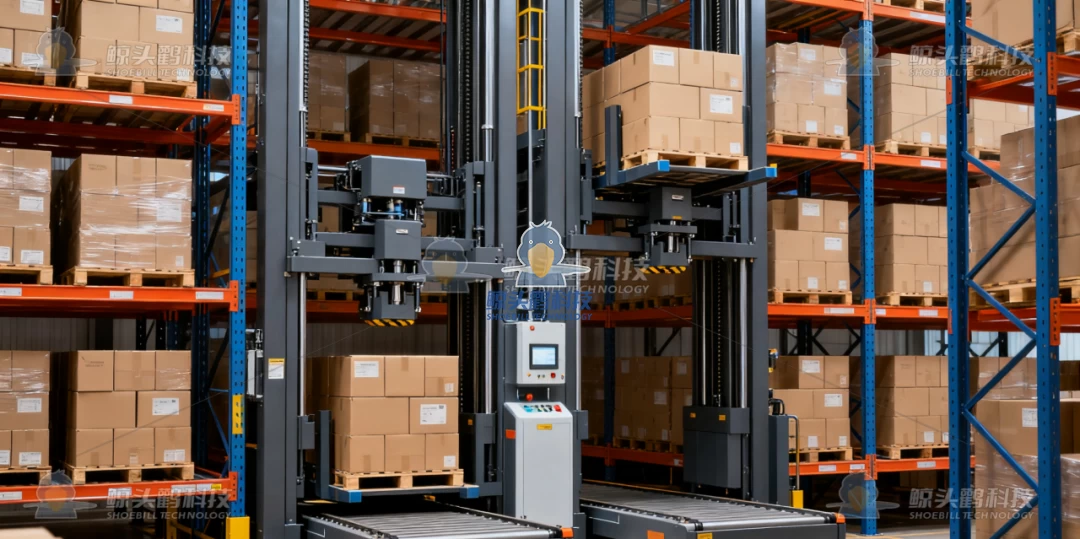
The integration of technology is a hallmark of smart warehouse planning. Modern warehouses rely on Warehouse Management Systems (WMS) and Manufacturing Execution Systems (MES) to enable end-to-end digital control of material handling—from inbound, storage, and picking to outbound shipments. Shoebill Technology equips warehouses with hand-held devices linked to shelf locations and material codes. When a production order is released, the system automatically triggers LED indicators on smart shelving units, guiding operators to the correct items. This intelligent picking mechanism doubles efficiency while minimizing human errors through visual alerts and warning lights.
High-density storage is another key aspect of smart warehouse planning, particularly in space-constrained facilities. Automated storage and retrieval systems (ASRS) allow vertical stacking of goods, utilizing cubic space more effectively than traditional shelving. Shoebill Technology customizes storage density based on throughput analysis and operational requirements, ensuring that equipment like stacker cranes and conveyors operate at optimal performance. The result is not only space efficiency but also faster access times, which significantly boosts order fulfillment rates.
One of the most transformative benefits of smart warehouse planning is real-time inventory management. Digital tracking enables precise control of material movements, reducing errors and ensuring timely replenishment. In a smart storage setup managed by Shoebill Technology, operators can retrieve or store items within 20 seconds with pinpoint accuracy. This level of precision increases inventory turnover rates by up to 50%, demonstrating how smart digital management enhances both speed and accuracy in warehouse operations.
A well-planned smart warehouse must also accommodate future growth. Smart warehouse planning includes scalable solutions that allow expansion without disrupting current operations. Modular storage units, flexible equipment allocation, and software-driven control systems ensure that as production volumes increase, the warehouse can adapt efficiently. Shoebill Technology designs systems with these principles in mind, allowing businesses to expand storage, upgrade automation, and integrate new technologies without major overhauls.
Safety and error reduction are integral to modern smart warehouse planning. Automated systems reduce manual lifting, minimize operator fatigue, and improve ergonomics. Smart alerts and digital guidance ensure that workers are directed to the correct locations and materials, decreasing picking mistakes. By combining high-tech automation with careful human-centric design, warehouses achieve not only faster throughput but also a safer working environment.
A prime example of smart warehouse planning in action is a smart storage installation in an industrial park, where digitalized operations enabled operators to pick and place materials within 20 seconds. This implementation resulted in a 50% increase in inventory turnover and significant reduction in errors, highlighting how precise planning, strategic layout, and technology integration can revolutionize warehouse efficiency.
Smart warehouse planning is no longer a luxury but a necessity for modern manufacturers and logistics providers aiming to optimize space, reduce handling times, and achieve accurate inventory management. By combining strategic layout design, high-density storage, digital management systems, and scalable automation, companies like Shoebill Technology demonstrate that intelligent warehouse solutions can substantially enhance operational efficiency. Adopting these planning principles allows businesses to stay competitive in an era where speed, accuracy, and flexibility are critical for success.

Add: Room 501, Building 1, Lane 668, Defu Road,Jiading District,Shanghai, China
Tel: 021-61354399
Contact: Mr. Chen